Frame-by-frame tracking
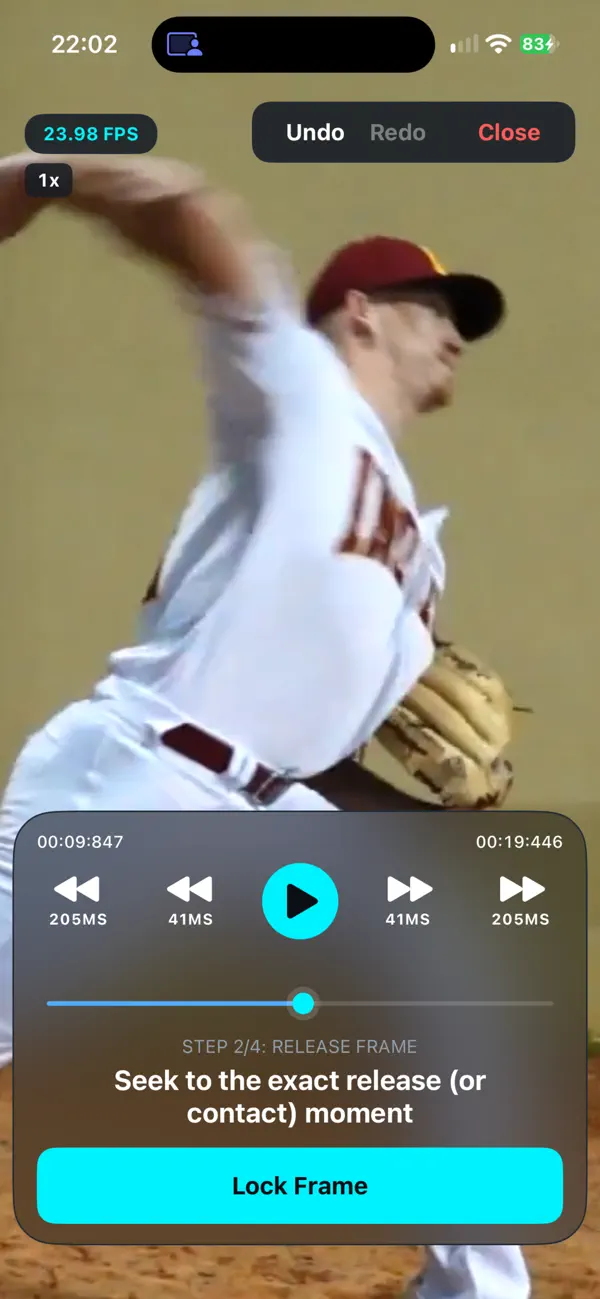
Lock the exact frame the ball leaves the hand or the bat, advance a few frames, tap the ball. The app converts pixels per frame into real ball speed using your device's recorded frame rate.
Film your pitch or swing, mark the bat and the ball, and Baseball Radar computes real ball speed frame by frame — no radar gun, no sensors, just your phone.
No AI estimates, no cloud magic. Baseball Radar measures distance over time, using your bat's real length as the on-screen ruler.
Lock the exact frame the ball leaves the hand or the bat, advance a few frames, tap the ball. The app converts pixels per frame into real ball speed using your device's recorded frame rate.
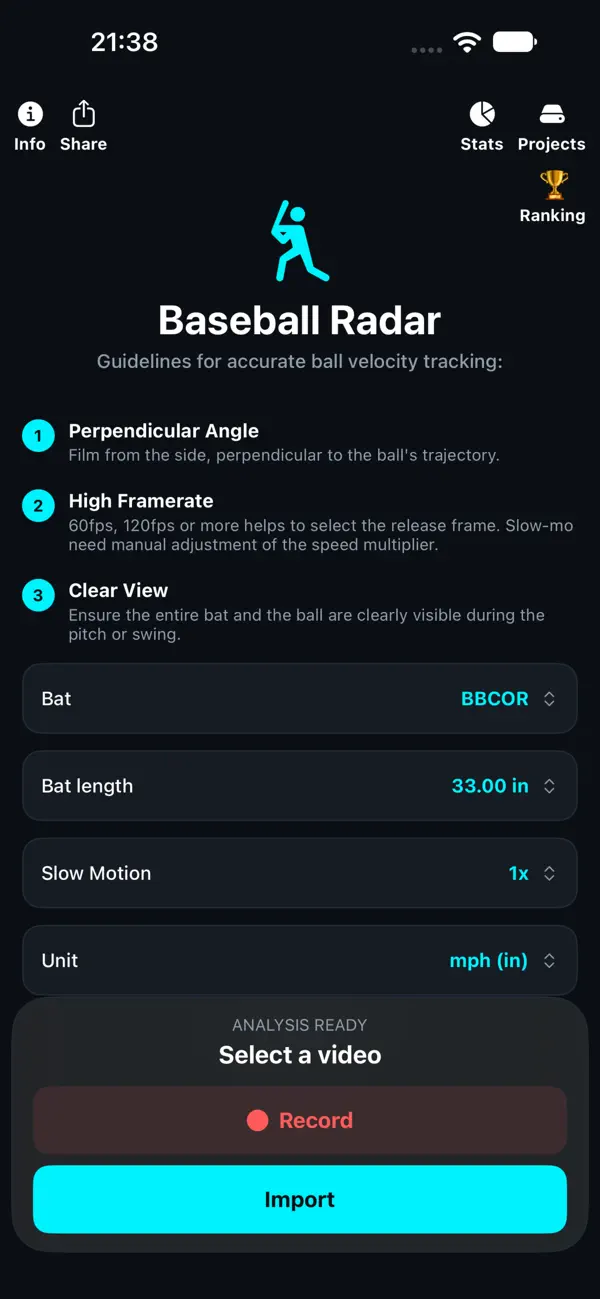
Tee-ball, youth, BBCOR, wood, softball or fungo — pick your bat and its real length calibrates the scene. Fine-tune it to match your own.
Shoot with the built-in high-framerate camera, or import any slow-mo pitch or swing already in your gallery.
Slow-mo metadata is detected automatically, or set the factor yourself — 1×, 1/2×, 1/4×, 1/8×, 1/16× — so the math always stays true.
Zoom deep into the frame to drop calibration and tracking dots with pixel accuracy.
No account, no uploads, no internet needed. Every frame is processed locally on your device — iPhone or Android.
Real screenshots from the App Store.
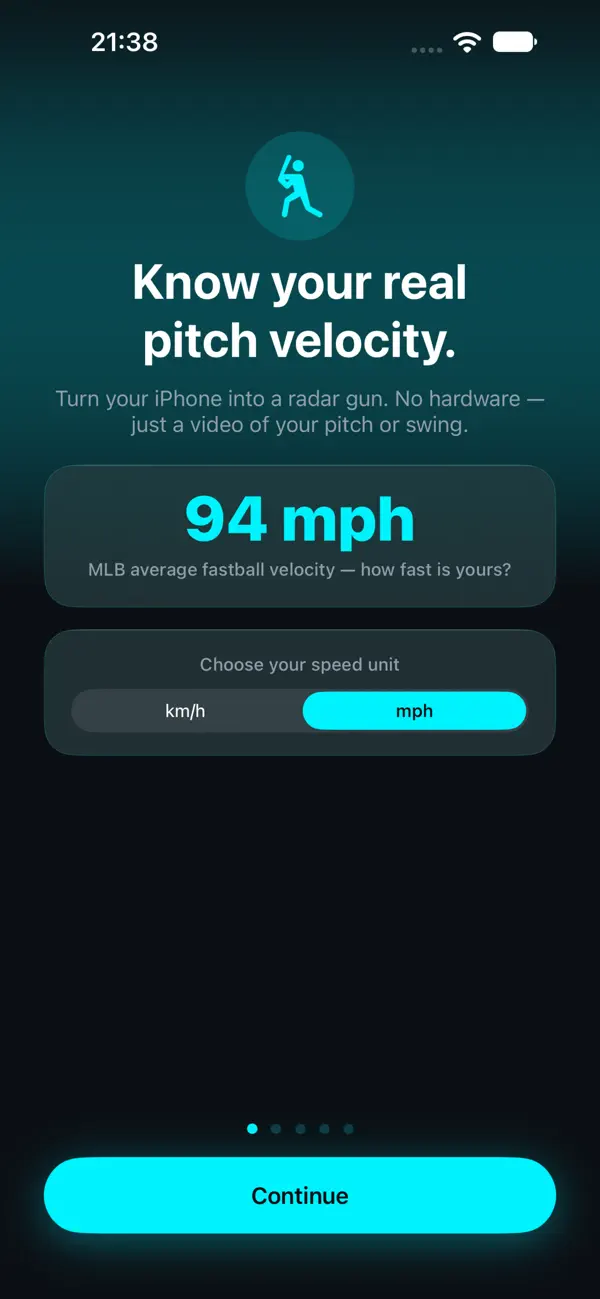
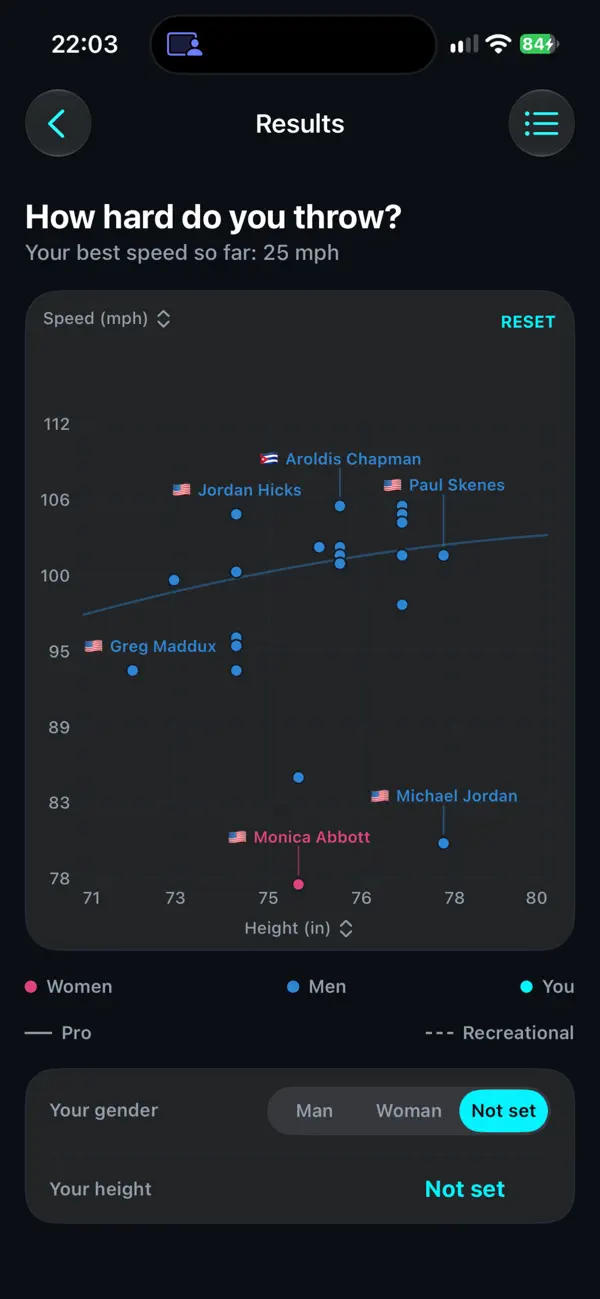
Pitch velocity and exit velocity are the clearest measures of progress. Track them across sessions and find out whether that mechanics tweak, new bat, or last lesson really made you faster.
Pick a pitch or swing video and isolate the moment of release or contact.
Step frame by frame to the millisecond the ball leaves the hand or the bat.
Drop a dot on the top of your bat, its knob, and the ball.
Advance 1–3 frames, tap the ball again — your speed appears in mph.
Each bat ships with its real-world default length — tweak it to match your own for dialled-in accuracy.
Common questions about measuring pitch speed and exit velocity with just an iPhone.
Baseball Radar analyses a pitch or swing video frame by frame. You mark the top and knob of your bat — its real length becomes the on-screen ruler — then tap the ball across two or three frames after release or contact. The app converts pixels per frame into real-world ball speed using your device's recorded frame rate. Pure geometry and physics, no AI guesswork.
Yes. Baseball Radar is free to download on the App Store for iPhone and iPad, and on Google Play for Android. It works with slow-motion videos you already have in your gallery.
Any iPhone, iPad or Android phone able to record slow-motion video works. For fastballs above 80 mph, 240 fps slow-mo (iPhone 8 and newer, recent Android flagships) gives the sharpest, most accurate readings.
Yes. Record inside Baseball Radar or import any slow-mo clip from your gallery. The app reads the embedded slow-motion factor automatically, or you can set the multiplier yourself — 1×, 1/2×, 1/4×, 1/8× or 1/16× — so the reading stays true to real-world speed.
With a stable phone, a side-on camera angle and at least 120 fps, Baseball Radar is typically within a few percent of a hardware radar gun — accurate enough to track progress, compare pitches and benchmark your swing.
Yes. Baseball Radar is available on Google Play for Android, alongside the App Store for iPhone and iPad.
Same idea, other sports — measure ball speed from any video.
Golf ball speed from your swing video, using your club's real length as the ruler.
Serve and groundstroke speed from any video, free on iPhone and Android.
Free to download. Works with pitch and swing videos you already have.